
 Manufacturer
EEP Type 4 Multi-Variable Steam Indicator
Product overview
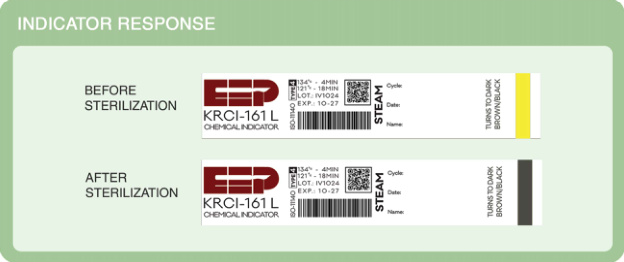
Designed to monitor specified steam-process variables inside the pack. Its yellow-to-dark-brown/black response, together with lot and expiry information, supports recording of results. Select the cycle and interpret the response according to the product instructions.
Product specifications
| Product code | KRCI-161L |
|---|---|
| Brand | EEP |
| Manufacturer | Krinmed |
| Indicator type | 4 |
| Dimensions, mm | 20 × 70 |
| Units per pack | 250 |
| Shelf life, months | 48 |
| Storage temperature | 15–30°C |
Instructions for use
Select the cycle, placement and result interpretation according to this product’s instructions. A chemical indicator result alone does not establish sterility.
KRCI-161L is identified as a Type 4 steam indicator. Its specified multivariable role should remain distinct from the cycle-specific role of the Type 6 model. Use the printed endpoint and model instructions to read its response. Indicator types identify different intended functions rather than a simple ranking from poor to best.
Where it fits in your workflow
An internal chemical indicator adds information from the location where it is placed inside compatible packaging. It complements the cycle record and the external process marker. Choose the indicator for the actual sterilization method and the monitoring task; a similar-looking strip for another process is not an interchangeable substitute.
Practical use guide
Check the model, lot, condition and instructions before use. Position the indicator in the location defined by the approved packaging and monitoring procedure. Keep the reactive area unobstructed as instructed. Run the compatible cycle, then assess the indicator at the specified stage without compromising the sterile barrier.
Reading and documenting the result
Compare the complete response with the acceptance reference for this model. A partial, unclear or unexpected response needs investigation. Link the observation to the load record and follow the facility procedure for handling a nonconforming pack. Chemical response provides process information at the indicator location, not independent proof that every item is sterile.
Practical benefits
An internal result can help staff recognise a mismatch between chamber records and conditions experienced within a pack. Model and lot identification support an organised investigation when results differ. The benefit comes from correct selection and consistent recording, rather than from the indicator type number alone.
Selection questions
Before ordering, confirm the sterilization method, cycle range, intended placement and required indicator type. Ask for the model-specific acceptance reference. For an EO application, also confirm the validated process conditions; an EO indicator is not a measurement of residual gas or evidence that aeration is complete.
Questions before ordering
What should I include in a technical enquiry?
Include the exact product name or code, equipment, process, packaging material and intended monitoring task. If you are replacing an existing product, provide its instructions and explain the application rather than requesting equivalence by appearance alone. Krinmed can then identify the relevant model documentation for your evaluation.
Can I use an image as the result reference?
No. Screen colour, lighting and image processing can alter the appearance of an indicator. Read an actual test against the current reference and instructions supplied for that product. Website photographs support identification and presentation; they are not a calibrated colour standard.