
Steam Quality: An Important Variable in Steam Sterilization Assurance
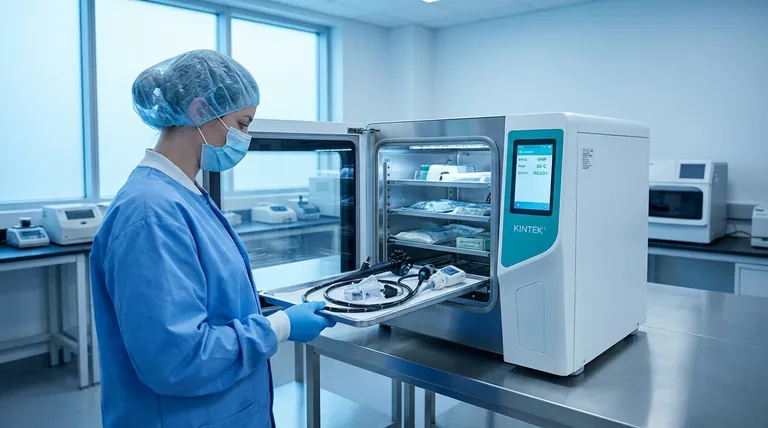
Steam sterilization is evaluated through a combination of mechanical records, chemical indicators, biological indicators, and other routine controls. These measures are essential, but they do not describe every characteristic of the steam supplied to or present within the sterilizer. Steam quality—including non-condensable gases, moisture content, and superheat—can affect steam contact, heat transfer, drying, and process performance.
The practical implication for central sterile services department (CSSD) and sterile processing teams is not that routine monitoring is inadequate. Rather, steam quality is one system variable to consider when recurring wet packs, unusual monitoring results, equipment changes, or unexplained process deviations occur.
What does “steam quality” mean?
In steam sterilization, the condition of the steam matters because effective sterilization depends on contact between the load surfaces and suitable saturated steam. Relevant concerns include:
- Non-condensable gases: Air or other gases that do not condense under sterilization conditions can occupy space that should be available for steam. This may interfere with steam contact and heat transfer, particularly in porous loads, lumens, packaging, or other difficult-to-penetrate locations.
- Excess moisture or wet steam: Steam containing excessive water may contribute to wet packs, inadequate drying, and inconsistent process performance.
- Superheated steam: Steam heated beyond its saturation point may not behave like saturated steam. A published study examined the detection of superheated steam during sterilization using biological indicators, underscoring that this condition warrants careful assessment rather than assumption.[2]
CDC describes dry saturated steam as the preferred sterilizing agent and identifies a dryness fraction of at least 97% in its steam-sterilization information.[1,3] This value should not be treated as a complete qualification program or as a universal substitute for equipment instructions and facility validation requirements. The applicable specifications depend on the sterilizer, steam system, load, and quality system.
Why steam quality can matter
Steam sterilization relies on effective contact between steam and the surfaces being processed. If air or other non-condensable gases remain in the chamber or load, conditions may be less uniform. A local area may not have the expected relationship between pressure, temperature, and saturated-steam conditions.
Evidence from a controlled study shows that non-condensable gases can influence the performance of physical, chemical, and biological monitoring systems. In that study, some indicators without a process challenge device did not detect small volumes of non-condensable gases under simulated chamber and door-seal failure conditions.[4] The finding was specific to the study conditions, indicator types, process challenge-device configuration, and tested circumstances. It should not be generalized to every indicator, sterilizer, or manufacturer’s system. It also does not mean that routine indicators should be abandoned; rather, indicator results should be interpreted as part of the complete monitoring and maintenance program.
Steam quality may also be relevant when processed items repeatedly emerge wet. A 2024 study at one hospital reported improved steam quality and fewer wet packages after an intervention that included infrastructure maintenance, preventive maintenance, qualification, and steam-quality testing.[5] Because multiple activities were involved, the findings do not establish that steam-quality testing alone caused the reduction. The single-hospital setting also limits generalization. Nevertheless, the report supports investigating the steam supply and sterilizer system when wet-pack events recur, rather than assuming that packaging technique is the only possible cause.
When should a CSSD investigate?
Steam-quality assessment may be reasonable when patterns such as the following occur:
- Recurring wet packs despite consistent loading, packaging, and unloading practices.
- Repeated Bowie-Dick or other air-removal test anomalies without an identified loading or operator cause.
- Biological, chemical, or physical monitoring results that are difficult to reconcile.
- Process changes following work on the sterilizer, steam system, building services, or equipment location.
- Repeated alarms, unusual conditioning or vacuum behavior, or unexpected cycle variation.
These observations do not by themselves prove defective steam quality. They should prompt a documented investigation that considers the load, packaging, cycle selection, equipment condition, utilities, and monitoring results together.
A practical investigation framework
1. Confirm and document the observation
Record the sterilizer, cycle, load identification, location and nature of any wetness or monitoring anomaly, package type, load configuration, and operator observations. Preserve relevant printouts, electronic records, indicators, and photographs when appropriate.
2. Review routine process information
Examine cycle time, temperature, pressure, alarms, vacuum phases, drying information, and any other data available for that sterilizer. Confirm that the correct cycle was selected and that the load was prepared and positioned according to validated instructions and the manufacturer’s directions.
3. Consider load and packaging causes
Review loading density, package configuration, instrument arrangement, pouch orientation, drainage, and the possibility that the load or packaging obstructed air removal or drying. This step helps distinguish a steam-system concern from a load-specific or handling-related event.
4. Escalate appropriately
If routine causes are not identified, involve qualified maintenance personnel and the sterilizer manufacturer as appropriate. The technical review should be based on the equipment’s design, manufacturer instructions, and the facility’s quality procedures. CDC guidance on management of a positive biological indicator identifies inadequate steam delivery and equipment malfunction among possible contributors to sterilization problems.[6] Although that reference addresses positive biological-indicator management rather than serving as a general steam-quality investigation protocol, it supports escalation when process concerns cannot be explained through routine review.
5. Test or qualify the steam system when justified
Depending on the process and equipment, assessment may include non-condensable gases, dryness, superheat, condensate, or other defined parameters. WHO guidance for sterile pharmaceutical manufacturing identifies non-condensable gases, dryness, and superheat as steam characteristics that may require periodic assessment in that setting.[7] This is pharmaceutical-manufacturing guidance and should not be presented as a direct healthcare-CSSD requirement. CSSD teams should determine applicability through their equipment documentation, validation program, qualified technical personnel, and governing quality procedures.
Testing should use suitable methods and competent personnel. Informal or isolated measurements should not be treated as formal process qualification.
What routine indicators can—and cannot—show
Mechanical records provide information about programmed or measured cycle conditions. Chemical indicators provide information about exposure to specified process conditions, and biological indicators challenge the process with resistant microorganisms. These tools are important, but none used alone provides a complete characterization of a facility’s steam supply.
Steam-quality testing is therefore complementary to—not a replacement for—mechanical, chemical, and biological monitoring. A steam-quality result also should not be used to disregard an unacceptable indicator, failed cycle, compromised package, or manufacturer instruction.
Practical implications for CSSD quality systems
- Include relevant changes to the steam system, water services, equipment, or infrastructure in change-control reviews.
- Trend wet-pack events and monitoring anomalies by sterilizer, cycle type, load family, and date.
- Define escalation criteria for recurring wet packs or unexplained monitoring discrepancies.
- Coordinate CSSD, facilities engineering, quality, infection-prevention, and equipment-service personnel when their involvement is appropriate.
- Document the technical rationale for returning equipment to routine use after investigation and corrective action.
Limitations
Steam-quality concerns vary with sterilizer design, steam-generation arrangements, load type, monitoring method, and facility infrastructure. Published evidence may involve controlled test conditions, specialized instruments, pharmaceutical manufacturing, or a single hospital and may not represent every healthcare CSSD. The evidence should therefore inform—not replace—manufacturer instructions, validated processes, applicable requirements, and the facility’s quality system.
Educational disclaimer: This article is for professional education. It does not provide patient-specific medical advice and does not replace applicable requirements, equipment instructions, validation, or qualified technical assessment.
Sources
- Centers for Disease Control and Prevention. Sterilizing Practices.
- Detection of Superheated Steam during Sterilization Using Biological Indicators. Biomedical Instrumentation & Technology; PubMed.
- Centers for Disease Control and Prevention. Steam Sterilization.
- Performance evaluation of chemical, biological and physical indicators in the process of sterilization under the effect of non-condensable gases. PubMed.
- Steam quality monitoring as a strategy to reduce wet packs and sterilization failure. American Journal of Infection Control; PubMed.
- Centers for Disease Control and Prevention. Table 12: Suggested protocol for management of positive biological indicator in a steam sterilizer.
- World Health Organization. WHO good manufacturing practices for sterile pharmaceutical products.
References
- Sterilizing Practices. Centers for Disease Control and Prevention. 2024-06-28.
- Detection of Superheated Steam during Sterilization Using Biological Indicators. Biomedical Instrumentation & Technology / PubMed. 2023-11-09.
- Steam Sterilization. Centers for Disease Control and Prevention. 2024-06-28.
- Performance evaluation of chemical, biological and physical indicators in the process of sterilization under the effect of non-condensable gases. PubMed. 2020-11-13.
- Steam quality monitoring as a strategy to reduce wet packs and sterilization failure. American Journal of Infection Control / PubMed. 2024-11-01.
- Table 12: Suggested protocol for management of positive biological indicator in a steam sterilizer. Centers for Disease Control and Prevention. 2023-12-20.
- WHO good manufacturing practices for sterile pharmaceutical products. World Health Organization. 2022-10-03.
Educational overview. Follow the applicable product instructions, validated procedures, local regulations and your facility’s approved policies.